
You have likely heard varying references to “BRICS” in various media or communication platforms like social media; but do you really know what BRICS means, or why people are using (and hearing) this term more frequently than before? Does BRICS mean just another political organization, or does BRICS also influence your life as an individual; the economy and globalization?
To think about what BRICS means; consider the way you typically work with your peers on a group project at school. For many years, only a small number of individuals had done all of the work and were making “all” of the decisions. As time has continued, more and more individuals are beginning to participate with their unique perspectives, talents and powers. BRICS represents those additional individuals; who represent new, or rising, voices (or individuals) that are attempting to disrupt the traditional power dynamic, and are attempting to change how things function globally.
1. What Does BRICS Stand For?
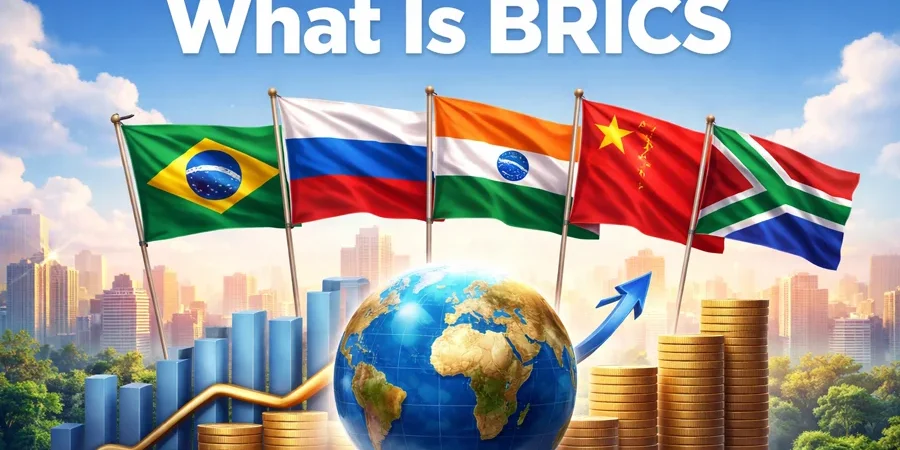
BRICS is an abbreviation for 5 Emerging Economies:
- Brazil
- Russia
- India
- China
- South Africa
Collectively these Countries founded a group to work together on Economic, Political and Social Issues. The aim of the Group was to give More Power to Emerging Economies rather than being ruled by Traditional Western Power Structures Through Controlling Global Decision Making.
Over the years BRICS grew from a Loose Economic Idea to a Formal Agreement with Annual Summits, Development Banks and Coordinated Global Policies.
2. Which Countries Are Part Of BRICS?
Original Members
Brazil, Russia, India, and China have been meeting since 2009 as the four original BRICS members. South Africa became the fifth BRICS member in 2010. The five BRICS nations represent:
- Over 40% of the world’s total population
- A significant portion of the global economy
- Some of the largest natural resources and industrial production facilities in the world
New Members And Interested Nations
Many other nations have recently expressed interest in joining BRICS or have already been invited to do so; these include countries from the Middle East, Africa, and Latin America. The growing number of prospective new BRICS members is evidence that BRICS is transitioning away from being a small political group to becoming a worldwide platform for developing nations.
3. Why Was BRICS Created?
A Response To Western Dominance
American and European countries have historically controlled most of the power over global financial institutions, like the International Monetary Fund (IMF) and World Bank. Many developing nations were frustrated because they felt that they were not being heard.
BRICS member nations were established to:
- Encourage a multipolar world order
- Encourage more influence for rising economies
- Encourage Collaboration among Emerging Nations
Economic Cooperation And Mutual Growth
Cooperation among BRICS members will enable them to become less reliant on traditional markets and partners in the West and develop stronger business relationships.
4. How BRICS Is Changing The Global Economy
The New Development Bank (NDB)
The New Development Bank is one of the most notable successes of BRICS. The NDB gives loans to developing countries in order for them to create new infrastructure or carry out sustainable development projects. Thus far, countries have been dependent upon banks in the developed world, particularly those from the West (with regard to loans). BRICS creates additional options and improves the bargaining power of developing nations.
Reducing Dependence On The US Dollar
BRICS wants to facilitate trade using local currencies instead of using the US dollar as a medium of exchange. If BRICS succeeds in achieving this goal, the dollar’s dominance will gradually lessen in global trade. This would represent a seismic shift in global finance’s landscape.
5. BRICS VS Western Alliances: What’s The Difference?
Different Priorities And Perspectives
While NATO and the G7 typically emphasize political and military cooperation, BRICS places a greater emphasis on:
- Economic development
- Infrastructure
- South-South cooperation (i.e., cooperation among developing countries)
Not A Military Alliance
In addition, it is critical to note that BRICS is not a military alliance. The members of BRICS do not agree to come to the defense of one another in the event of a war. Rather, its goal is to change the economic and diplomatic relationships that exist today.
BRICS is, therefore, more an economic coalition than a traditional political alliance.
6. Recent Expansion: Why BRICS Is In The Spotlight Now
Growing Global Interest
There has been an increase in the number of countries applying and/or showing interest to join the BRICS over the last several years. Countries have turned to the BRICS as an alternative to the current systems dominated by the “West” which few countries view as representing their interests.
Increased interest is making BRICS front-page news and raising discussions about BRICS possibly becoming a new global power.
Shifting Global Power Dynamics
Several countries around the world are now experiencing rapid economic growth, and they are showing how BRICS represents the changing global economic environment that will soon be characterized as “attractively” multipolar—–where global leadership is distributed among many major players rather than the current structure of a monopoly by one country/company/individual.
7. What BRICS Means For Ordinary People?
You may think, why should I be concerned with BRICS?
Because BRICS will affect you in ways that go beyond what is on the news.
They will be determining:
- Your fuel prices
- Your job opportunities
- How international trade works
- Offering stability to all countries that participate in BRICS
If BRICS Countries were to begin using their own currencies more instead of the US dollar for trade, this could cause a shift in the exchange rate between the two currencies, meaning that the price of imported goods would rise in your country.
To put it simply, the conduct of BRICS countries in meetings will ultimately determine how much you will pay for groceries and fuel at the pump.
8. The Future Of BRICS: What Comes Next?
Challenges Within The Group
Although BRICS has been gaining influence in global affairs, the group has not come without challenges. BRICS’ members are often from different types of political systems and have different types of economic priorities, and there are issues surrounding borders. Additionally, BRICS members often have trouble working together and agreeing on important decisions.
Potential To Reshape Global Governance
However, BRICS also demonstrates that it can have a tremendous amount of power if it continues to develop, expand its membership, and create stronger finance institutions. If so, BRICS can impact:
- Global trade rules
- Climate change project funding
- Development decisions
As a result, BRICS in many ways depicts an emerging world that is less focused on the West and more representative of the diversity of the population globally.
Conclusion
The BRICS (Brazil, Russia, India, China and South Africa) started out as an initiative designed to create a stronger voice for some of the largest emerging economies in the world on the global scene. It has now developed into one of the most talked-about international alliances in terms of politics and economics.
With an increasing number of countries seeking membership and the realignment of global power dynamics, BRICS has become more than merely an acronym. It has become representative of a world that is undergoing significant change. As such, it will be increasingly necessary to understand BRICS if one wishes to understand the future direction of the international system.