

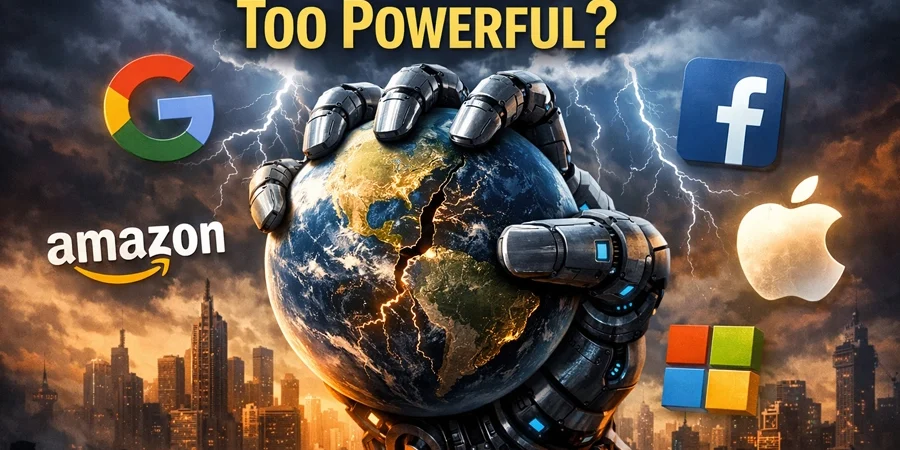
Consider the frequency with which you look at your phone, look up something online or scroll through various social media platforms. Most likely you are using the services of only a small number of the major technological companies. These companies influence our lives through their products and services, and provide the means for communication, shopping, entertainment, and work. With this in mind, we should consider whether there is something wrong with how much power these large technology companies have amassed and if we should be worried about their dominance.
1. The Rise of Big Tech Giants
How Tech Companies Grew So Quickly
In a little over 20 years, and starting from garage or dorm room operations, some very large technology companies (such as Google, Apple, Facebook, and Amazon) have grown into multinational companies, serving billions of people. Driven by innovation, sound business strategies, and the rapid growth of the Internet, the growth of these companies has been phenomenal.
From Useful Tools To Digital Empires
Originally, they each provided a few simple solutions to specific problems; for example: creating search engines, selling books online, and creating social networking websites. Today, they have become players in creating complete ecosystems. For instance, a company who produces the operating system for your smartphone may also produce the app store, provide you with an email service, and store your files in the cloud. In other words, it is almost as if one company owns all the roads in the city and all the cars on the road, as well as all the traffic lights and where to fill up your gas tank.
2. Why Big Tech Holds So Much Power?
Network Effects And User Dependency
One reason that big tech companies have so much power is because of the systemic effect. When many people use a product or service, the product or service has a large amount of value. For example, you would only be able to use a messaging app if your friends are using that same app. Businesses will sell their products or services through advertising on certain platforms if that is where the largest number of their potential customers are.
Control Over Data And Infrastructure
Another aspect of power is the collection of data. Each search, click on, or complete purchase uses information created from that transaction. Large tech companies collect this information from each transaction and analyze the information to provide customers with better service and target advertisements more effectively. Over the course of time, large tech companies build massive amounts of data that can be difficult to match by small competitors. This user-dependent data gives large tech companies a significant advantage over their competitors and allow them to influence which trends, preferences, and opinions to pursue.
3. The Benefits Of Big Tech In Everyday Life
Convenience And Innovation
To be fair, large tech has made life more convenient for people. It is possible to buy groceries, participate in business meetings, acquire new capabilities, and communicate with family members across the globe with your smartphone. Service delivery times are decreasing; service delivery costs are declining; and service delivery processes are getting less expensive and more effective.
Creating Jobs And New Opportunities
In addition to the traditional job opportunities created by these companies (i.e., direct job creation), they have also generated millions of indirect employment opportunities as a result of the new markets created by all these jobs. App developers, online retailers, digital marketers, and content producers depend on large technology companies to promote their products and earn income. Big tech has opened up countless pathways for many people that did not exist before.
4. Concerns About Privacy And Data Control
How Much Do They Know About You?
Okay, let’s get uncomfortable. Most people truly don’t realize how many things about themselves they’re putting on the web. Whether you post pictures showing where you are, what you’re searching for, or what you’re buying, there’s a company out there that can take all this information and piece together a very complete and accurate picture of who you are. This data can also be used to create targeted ads for you or lead other harmful effects related to your privacy.
The Risk Of Data Misuse
When a few companies have so much information on so many individuals, it increases the possible dangers. Possible data breaches and possible misuse of data and manipulation of users through personalized content are valid concerns. It’s like giving your diary to someone you don’t know and trusting that they won’t read it or share it.
5. The Impact On Small Businesses And Competition
Big Tech VS. Small Players
One of the most significant concerns of concern with regards to competition is the impact of large tech companies on competition by limiting access to capital and limiting competition with a company by virtue of having access to financial resources and large numbers of customers. If a small business develops a technology that has been proven successful, it will be very easy for larger technology companies to duplicate those technologies or purchase those companies before the startup can become a serious competitor.
Market Control And Limited Choices
If a small number of firms have monopolised an industry, consumers may be restricted with their purchase choices. Large suppliers are the ones to set product prices, create policies governing the way products are marketed, and determine product specifications. This will ultimately hinder new entrants from entering the industry and decrease overall innovation in the long term.
6. Governments VS. Big Tech: A Growing Battle
Calls For Regulation And Antitrust Laws
Attention from worldwide governments is being drawn as lawmakers are questioning the level of dominance that Big Tech Companies have gained. Furthermore, they are considering whether stricter regulations may be needed for these companies. Antitrust investigations, privacy laws, and proposed regulations all seek to limit the power of these corporations and provide a fair playing field for their competitors.
The Challenge Of Regulating Global Companies
While regulating “Big Tech” can be very difficult. There are large multinational companies that operate across multiple countries which each have their own unique laws, regulations and priorities. What may be acceptable behavior in one country may not be acceptable in another, so enforcing regulations on large multinationals can become very complicated, and usually they do not take effect until a long period of time has passed.
7. What The Future Might Look Like
More Rules Or More Innovation?
Over the next few years, more stringent regulations will likely be introduced regarding:
- Data privacy
- Competition
- Responsibilities of platforms
These developments may create a more level playing field in the digital space, granting individuals greater authority and smaller businesses more running room to expand.
Your Role As A User
In order to contribute positively to technology, it’s important that we all understand our part in the system. By being aware of how our data is handled, selecting services carefully, and backing responsibly run companies, we can steer the larger ecosystem of tech in a more ethical direction. Ultimately, the majority of the influence that large technology companies have on everyday life is due to the billions of users (including you) that use their platforms every day.
Conclusion
How powerful has Big Tech have become? The answer isn’t clear-cut as big tech has changed our lives for the better by providing a lot of conveniences, innovations, and opportunities; however, its growth has led to concerns regarding data control/ownership, marketplace control, and infrastructure ownership, etc.
An analogical way of thinking about Big Tech is that it is like a large tree in an area of limited space; although it produces shade and protection for others to benefit from, if it grows too large it will obstruct the sunlight from other plants. Society’s challenge will be to discover a balance between reaping the advantages of big tech while avoiding the negative impacts of big tech’s future growth on the overall digital ecosystem.