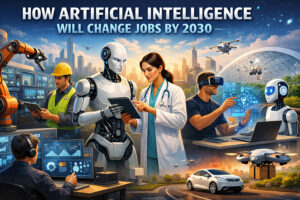


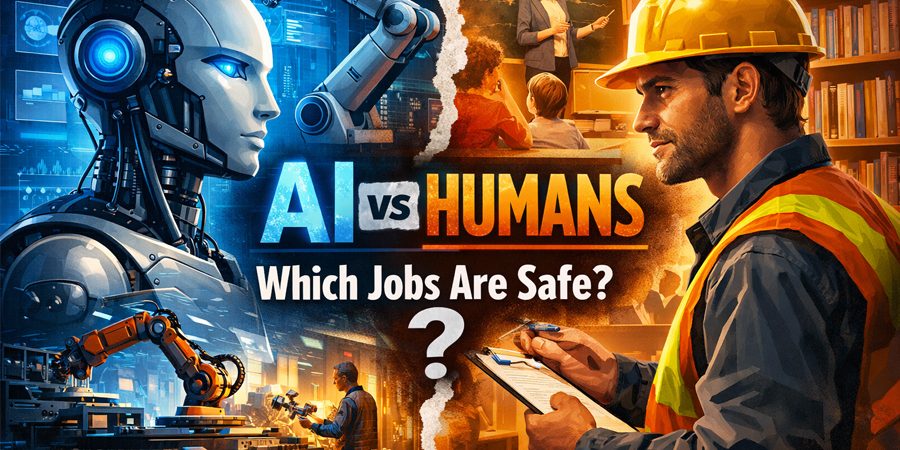
Artificial intelligence (AI) is no longer a concept from science fiction. It is here. AI can write emails, drive cars, attend to customer queries, and even produce artwork. So naturally, you might be wondering: Will AI take my job? Or, even more importantly, which jobs are safe from AI?
Let’s face it, this question seems almost like a personal matter. The emergence of AI impacts each one of us, whether you are a student deciding on a career, a professional mapping out your future, or a business owner who’s embracing change.
Consider AI as a brand-new powerful tool, just like when electricity or the internet were first introduced. Most people thought these advances would stop work. Actually, they just changed it. The same thing is happening now.
Understanding AI and Automation
So before we go about saying which kind of jobs will remain safe, let’s first understand what AI essentially accomplishes.
What AI Does Well
AI is very good at:
- Repetitive tasks
- Data analysis
- Pattern identification
- Work fast and accurate
If a job simply involves following a set of rules to the letter that can be done repeatedly in the same way, then probably AI can do it.
What AI Struggles With
Conversely, AI finds it difficult:
- To have a deep emotional connection
- To complex human communication
- To make ethical decisions
- To create within a context
Hence, AI can be considered intelligent, but it is not a human.
Jobs Most at Risk from AI
Some careers are more susceptible than others.
Repetitive and Routine Jobs
The higher risk is for predictable task jobs such as:
- Data entry clerks
- Telemarketers
- Cashiers
- Basic bookkeeping
Such jobs depend on a rigid sequence of steps. AI machines and automation gadgets can do them more quickly and at less cost.
Basic Content and Customer Support
Automation is creeping into even the lowest level writing and chat support. AI chatbots can respond to FAQs right away. On the other hand, they find it difficult to deal with complicated emotional situations.
So are these jobs at risk of disappearance? No, but their size will lessen or they will change substantially.
Jobs That Are Safe from AI
Now here’s the good news: there are a lot of jobs that will still be around without AI, at least for the next few years.
Healthcare Professionals
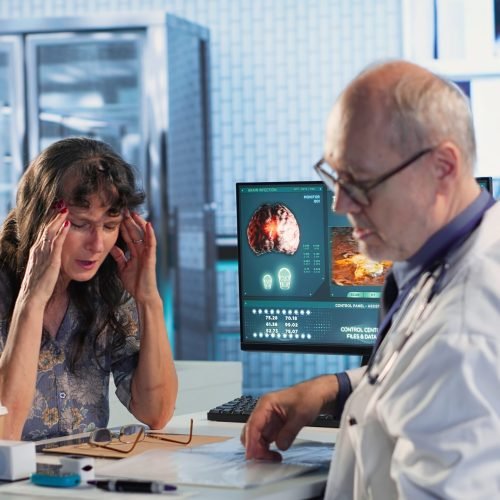
Doctors, nurses, therapists, and caregivers depend a lot on empathy, trust, and human intuition. AI might help them figure out what’s wrong with a patient, but it can’t take over the human aspect of care.
Would you trust a robot to tell you that you have a life-threatening illness? No, right.
Creative Professionals
Writers, designers, filmmakers, musicians, creativity is something that is deeply human. Sure, AI is capable of producing content, but genuine storytelling and emotionality stem from real experiences.
Skilled Trades
Electricians, plumbers, carpenters, mechanics, these jobs of working physically with the environment require coming up with solutions on the spot in changing situations. Robots have difficulties in working in the real world, which is full of changes, unpredictability, and different factors.
Leadership and Management Roles
Administrators, businessmen, and executives decide on a complicated mixture of factors involving people, feelings, and strategies. AI can give them data, but it is still human who makes the ultimate decision.
Why Human Skills Still Matter
Soft skills are a pretty big deal, don’t you agree?
Emotional Intelligence
These are things that are naturally human: understanding the feelings of others, creating a safe space for trust to grow, and finding a way to agree when there is disagreement. A machine, an AI, cannot feel stress, he/she/it cannot feel happiness or empathy.
Critical Thinking
Artificial Intelligence just analyzes the information. People give the information a sense. People do that a lot more than machines.
Adaptability
Humans can re-skill themselves, be a different version of themselves, and come up with ideas even in a messy situation. That kind of firm is our greatest power.
In the battle of AI vs humans, adaptability is our secret weapon.
How to Future-Proof Your Career
Instead of worrying whether AI will might make your job redundant, think of the ways that AI can be a good working partner for you.
Learn Digital Skills
Learning about AI solutions, data fundamentals, and overall tech know-how will set you apart.
Strengthen Human Skills
People skills such as communication, leadership, creativity, and empathy will not lose their value.
Keep Learning
We are witnessing a rapid transformation of the labor market. Therefore, lifelong learning has become an imperative rather than a choice.
You can compare your professional life to a mobile device. If you fail to upgrade it from time to time, it will soon become a complete dinosaur.
AI and Humans Working Together
The reality is: it’s not AI versus human beings. It’s AI and human beings.
AI takes care of the hard tasks, such as analyzing large data in a flash. Humans therefore can concentrate on strategy, relationships, and innovation.
Take these examples for instance:
- Medical professionals utilize AI to identify illnesses at a much quicker rate.
- Marketers leverage AI to study customer behaviors.
- Authors employ AI toolkits to come up with new ideas.
When working together, output rises. Efficiency becomes better. Creativity gets a boost.
The future workspace will be the one where people who are skilled in AI would be the winners, those who would be afraid of AI will be the losers.
The Real Question: Adapt or Resist?
History shows us something important. When new technology appears, some people resist it. Others adapt and thrive.
During the industrial revolution, machines replaced manual labor in many areas. But they also created new industries and millions of jobs.
AI is no different.
Yes, some roles will disappear. But new ones will emerge:
- AI trainers
- AI ethicists
- Automation specialists
- Human-AI collaboration experts
The job market is shifting — not collapsing.
Conclusion: So, Which Jobs Are Safe?
The most secure jobs from AI are those that need human contact, creativity, complex decision-making, and flexibility. Jobs that are solely based on repetition have a higher risk.
Rather than worrying about AI, we should concentrate on developing the talents that make us different from machines.
AI is just like a very strong motor. It can take us to a higher speed, but only if we control it.
So, what do you think? Are you willing to take charge of your future?
The future of work is not about AI taking over humans. It is about human beings growing alongside AI.
And anyway, it is a task we can do very well.